Here are ten awesome art installations that turn ordinary places into extraordinary experiences.
Ghost Installation (“My Mind”) — Jakub Hadrava, Czech Republic
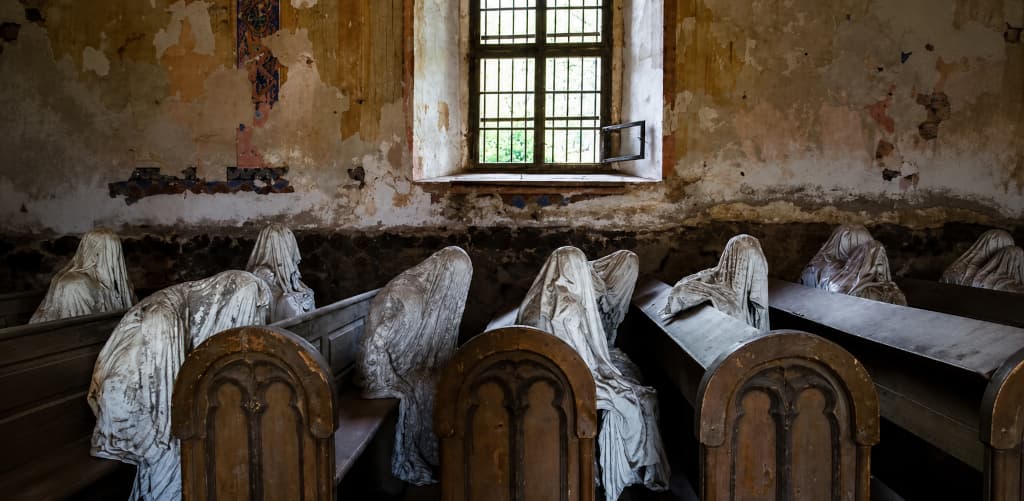
Walk into the abandoned St. George’s Church in Luková, Czech Republic, and it can feel as if the building is still occupied. Life-size human figures sit quietly on the church benches, their heads lowered and bodies covered in pale fabric.
Created by Czech artist Jakub Hadrava in 2012, Ghost Installation, also known as My Mind, contains 32 life-size figures. The figures represent the Sudeten Germans who once lived in the village. Hadrava created the installation partly to attract visitors and help raise money for the restoration of the deteriorating church.
The Nine Muses — Bettina Eichin, Germany
Despite sometimes being associated with Switzerland because Bettina Eichin is a Swiss artist, The Nine Muses (Die neun Musen) are installed in Freiburg, Germany, at the University of Freiburg. The nine life-size figures are made of bronze and wrapped in heavy robes.
Created between 1978 and 1992, Eichin’s muses look nothing like the graceful figures normally associated with classical mythology. They sit or lie down, appearing tired, serious, and deep in thought.
That is the point. Eichin uses the nine women to explore history, responsibility, memory, and the position of women. Instead of dancing or celebrating, the muses appear to carry a heavy burden.
Les Voyageurs — Bruno Catalano, France
What happens when a person is missing a huge part of their body — but somehow keeps walking?
That is the strange effect created by French sculptor Bruno Catalano in Les Voyageurs. His bronze travelers have enormous sections missing from their bodies. Each figure carries a suitcase, making the sculptures look as if they have just arrived somewhere or are about to leave.
The series was exhibited in Marseille in 2013 during Marseille-Provence’s year as European Capital of Culture. The missing sections are not simply a visual trick. Catalano has connected the figures with the experience of travel, migration, loss, and leaving part of yourself behind.
The Awakening — J. Seward Johnson Jr., USA
A gigantic man appears to be fighting his way out of the ground.
That is The Awakening, a sculpture by American artist J. Seward Johnson Jr. The five-piece cast-aluminum figure shows a distressed giant emerging from the earth, with his arms, legs, and head breaking through the surface.
The sculpture is 72 feet long and is now installed at National Harbor in Maryland, where it has become one of the area’s best-known landmarks. From a distance, it looks like a giant is literally trapped underground.
Rain Room — Random International
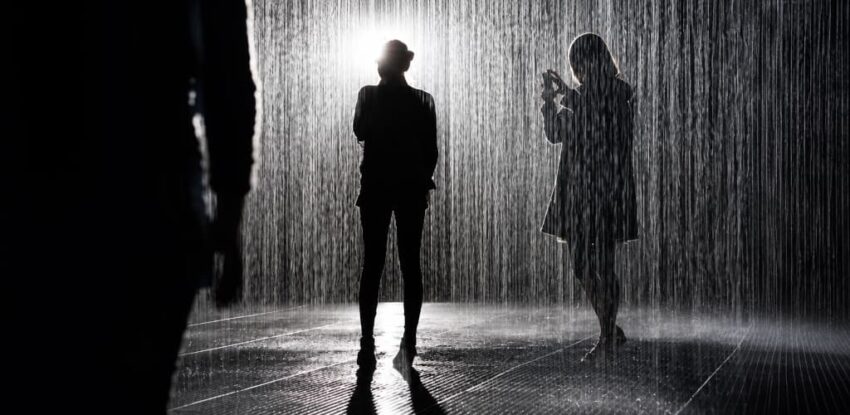
Imagine walking through heavy rain while staying completely dry.
That is the basic idea behind Rain Room, created by the London-based art collective Random International in 2012. The installation fills a large room with continuously falling water, but sensors detect visitors and stop the rain immediately around them.
Rain Room has been presented at venues including the Barbican in London, MoMA in New York, LACMA in Los Angeles, and the Yuz Museum in Shanghai.
Field of Light — Bruce Munro
British artist Bruce Munro turns landscapes into giant fields of light with Field of Light.
The installation consists of thousands of illuminated stems topped with glowing spheres. One of its largest and best-known versions appeared near Uluru in Australia’s Northern Territory, where about 50,000 lights covered more than 49,000 square meters.
The Weather Project — Olafur Eliasson, UK
In 2003, Danish-Icelandic artist Olafur Eliasson brought an artificial sun into Tate Modern’s Turbine Hall in London.
The Weather Project used a huge semicircular screen, mirrors, artificial mist, and around 200 monofrequency lights. Together, they created the illusion of an enormous glowing sun hanging inside the museum.
The ceiling was covered with reflective material, doubling the visual height of the space. Visitors could see themselves reflected in the installation and often sat or lay on the floor simply watching the artificial sky.
The installation ran from October 2003 to March 2004 and became one of Tate Modern’s most recognizable large-scale installations.
Sea Change — Patrick Dougherty, USA
Patrick Dougherty’s Sea Change was created at Naples Botanical Garden in Florida in 2021. Dougherty and his son, Sam, worked with nearly 100 volunteers to transform around 30,000 pounds of willow saplings into a huge sculptural structure.
The finished work measured about 70 feet long, 20 feet wide, and 15 feet high. Dougherty calls these creations “Stickwork.”
The Floating Piers — Christo and Jeanne-Claude, Italy
For a short time in 2016, visitors could literally walk across Lake Iseo in Italy.
The Floating Piers was created by artists Christo and Jeanne-Claude. The project connected the lakeside town of Sulzano with Monte Isola and the island of San Paolo, creating a bright pedestrian walkway across the water.
Infinity Mirrored Room — Yayoi Kusama
Japanese artist Yayoi Kusama has created more than twenty distinct Infinity Mirror Rooms over her career. Her installations use mirrors, lights, and repeated forms to create the illusion of endless space.
One of the earliest was Infinity Mirror Room — Phalli’s Field, created in 1965. Later versions introduced LED lights, glowing objects, and other repeated forms. Visitors become part of the artwork because their own reflections are multiplied across the mirrored surfaces.